
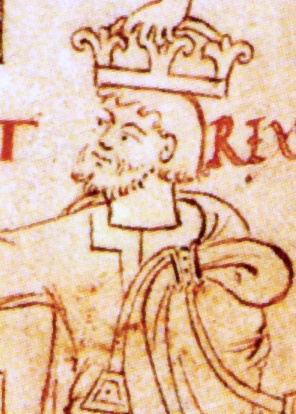
 On this day, 1009 years ago, November 30 1016, Cnut of Denmark (his name was anglicized to “Canute” somewhere along the way) claimed the throne of all of England following the death of King Edmund, known as “Ironside” for his valiant resistance against the Danes. Canute was 22 at the time, and a couple of years later he claimed the throne of Denmark, and later, that of Norway. The story of his triple ascension, even if you only get through the Wikipedia rendition, makes for very good–although complicated–reading, and includes characters such as Sven Forkbeard, Sigrid the Haughty, and Eric the Victorious. (It gets better, the more you read…)
And so, roughly fifty years before William the Conqueror invaded England from the Southeast, Canute took over England, sailing down from Denmark and landing at Wessex. Strenuous fighting ensued along the way (Canute was already known as a warrior-prince) until he ended up in London, which was under siege for several months, eventually ending in an agreement that all land north of the capital was ceded to Canute, while the English King Edmund continued his dominion over the land to the south–said land to pass to Canute upon Edmund’s death. Edmund died within a few weeks of the treaty (no word on Hillary Clinton’s whereabouts at the time, other than to say that it is not widely believed that Edmund committed suicide), and Canute was crowned King of all England.
He’s regarded, by the standards of the time, as a rather good and just king, but his reputation for specific kingly virtues pales in comparison to the thing that we all know about him, which is that he was the foolish, proud, delusional monarch who thought that he could hold back the tides, and was humiliated, mortified and embarrassed when that was shown not to be the case.
Oops. Perhaps not so much.
The first recounting of the tale of “Canute and the Waves” comes from Henry of Huntingdon, in his twelfth-century Historia Anglelorum (OK, a century or so after Canute died, but a hell of a lot closer to his life than are we). Henry explained the episode this way:
… when he was at the height of his ascendancy, he ordered his chair to be placed on the sea-shore as the tide was coming in. Then he said to the rising tide, “You are subject to me, as the land on which I am sitting is mine, and no one has resisted my overlordship with impunity. I command you, therefore, not to rise on to my land, nor to presume to wet the clothing or limbs of your master.” But the sea came up as usual, and disrespectfully drenched the king’s feet and shins. So jumping back, the king cried, “Let all the world know that the power of kings is empty and worthless, and there is no king worthy of the name save Him by whose will heaven, earth and sea obey eternal laws.” Thereafter King Cnut never wore the golden crown on his neck, but placed it on the image of the crucified Lord, in eternal praise of God the great king. By whose mercy may the soul of King Cnut enjoy rest.
So the first, and almost-contemporaneous, account describes a Canute who’s tired of the fawning sycophancy of his nobles, and who decides to teach them a lesson and show them that even the power of kings is limited by eternal laws and divine providence. Whether or not it’s a faithful depiction of his actions (Lord knows, contemporaneity with events is no guarantee of accuracy or fairness when it comes to news coverage–we see that every day), it was the story that was passed down for generations: Canute the Meek; Canute the Pious; Canute the Devout; Canute who hung up his crown on the crucifix and never wore it again after showing his courtiers that he, too, was mortal and no more able to alter the course of divine will than any of his subjects.
This image of Canute held up until well into the nineteenth century, as evidenced in a rather bad and doggerely poem by William Makepeace Thackeray, the author of Vanity Fair. (The novel, not the magazine.) Here’s Thackeray’s entire (awful) poem, just to make that point, and perhaps a couple of others:
KING CANUTE was weary hearted; he had reigned for years a score,
Battling, struggling, pushing, fighting, killing much and robbing more;
And he thought upon his actions, walking by the wild sea-shore.‘Twixt the Chancellor and Bishop walked the King with steps sedate,
Chamberlains and grooms came after, silversticks and goldsticks great,
Chaplains, aides-de-camp, and pages,—all the officers of state.Sliding after like his shadow, pausing when he chose to pause,
If a frown his face contracted, straight the courtiers dropped their
jaws;
If to laugh the king was minded, out they burst in loud hee-haws.But that day a something vexed him, that was clear to old and young:
Thrice his Grace had yawned at table, when his favorite gleemen sung,
Once the Queen would have consoled him, but he bade her hold her tongue.“Something ails my gracious master,” cried the Keeper of the Seal.
“Sure, my lord, it is the lampreys served to dinner, or the veal?”
“Psha!” exclaimed the angry monarch, “Keeper, ’tis not that I feel.“‘Tis the HEART, and not the dinner, fool, that doth my rest impair:
Can a king be great as I am, prithee, and yet know no care?
Oh, I’m sick, and tired, and weary.”—Some one cried, “The King’s arm-
chair!”Then towards the lackeys turning, quick my Lord the Keeper nodded,
Straight the King’s great chair was brought him, by two footmen able-
bodied;
Languidly he sank into it: it was comfortably wadded.“Leading on my fierce companions,” cried he, “over storm and brine,
I have fought and I have conquered! Where was glory like to mine?”
Loudly all the courtiers echoed: “Where is glory like to thine?”“What avail me all my kingdoms? Weary am I now and old;
Those fair sons I have begotten, long to see me dead and cold;
Would I were, and quiet buried, underneath the silent mould!“Oh, remorse, the writhing serpent! at my bosom tears and bites;
Horrid, horrid things I look on, though I put out all the lights;
Ghosts of ghastly recollections troop about my bed at nights.“Cities burning, convents blazing, red with sacrilegious fires;
Mothers weeping, virgins screaming vainly for their slaughtered
sires.—”
“Such a tender conscience,” cries the Bishop, “every one admires.”“But for such unpleasant bygones, cease, my gracious lord, to search,
They’re forgotten and forgiven by our Holy Mother Church;
Never, never does she leave her benefactors in the lurch.“Look! the land is crowned with minsters, which your Grace’s bounty
raised;
Abbeys filled with holy men, where you and Heaven are daily praised:
YOU, my lord, to think of dying? on my conscience I’m amazed!”“Nay, I feel,” replied King Canute, “that my end is drawing near.”
“Don’t say so,” exclaimed the courtiers (striving each to squeeze a
tear).
“Sure your Grace is strong and lusty, and may live this fifty year.”“Live these fifty years!” the Bishop roared, with actions made to suit.
“Are you mad, my good Lord Keeper, thus to speak of King Canute!
Men have lived a thousand years, and sure his Majesty will do’t.“Adam, Enoch, Lamech, Cainan, Mahaleel, Methusela,
Lived nine hundred years apiece, and mayn’t the King as well as they?”
“Fervently,” exclaimed the Keeper, “fervently I trust he may.”“HE to die?” resumed the Bishop. He a mortal like to US?
Death was not for him intended, though communis omnibus:
Keeper, you are irreligious, for to talk and cavil thus.“With his wondrous skill in healing ne’er a doctor can compete,
Loathsome lepers, if he touch them, start up clean upon their feet;
Surely he could raise the dead up, did his Highness think it meet.“Did not once the Jewish captain stay the sun upon the hill,
And, the while he slew the foemen, bid the silver moon stand still?
So, no doubt, could gracious Canute, if it were his sacred will.”“Might I stay the sun above us, good sir Bishop?” Canute cried;
“Could I bid the silver moon to pause upon her heavenly ride?
If the moon obeys my orders, sure I can command the tide.“Will the advancing waves obey me, Bishop, if I make the sign?”
Said the Bishop, bowing lowly, “Land and sea, my lord, are thine.”
Canute turned towards the ocean—”Back!” he said, “thou foaming brine.“From the sacred shore I stand on, I command thee to retreat;
Venture not, thou stormy rebel, to approach thy master’s seat:
Ocean, be thou still! I bid thee come not nearer to my feet!”But the sullen ocean answered with a louder, deeper roar,
And the rapid waves drew nearer, falling sounding on the shore;
Back the Keeper and the Bishop, back the king and courtiers bore.And he sternly bade them never more to kneel to human clay,
But alone to praise and worship That which earth and seas obey:
And his golden crown of empire never wore he from that day.
King Canute is dead and gone: Parasites exist alway–W.M. Thackeray, in the public domain
I cannot think of it as peerless poesy or as anything other than another rather forced rhyme; however, I heartily endorse the sentiment of the last line.
But somewhere along the way and not all that long ago, while the essential story didn’t change, the characterization of Canute and his motives went completely sideways, and he became Canute the Deluded, Canute the Narcissist, and Canute the Megalomaniac. Canute who thought he could order the tides not to roll in. (Don’t believe me, just Google “King Canute Donald Trump” for multitudinous, and multifarious comparisons. You’ll get the idea.)
And we now live in a world where Canute, more often than not, is held up as an exemplar of arrogance and power gone mad, of the King who thought he could hold back the tide; who could stop the waves from rolling in; and who could control the forces of nature without being subject to them himself. The King who was humiliated by, and who was shown to be powerless, in the face of nature itself.
Sorry, no.
I’m going with the stories. With the myths. With the millennium of example. And I’m holding with my previously expressed idea in posts both here and on Ricochet, that there is something very special about the English, in that the only two of their monarchs dignified with “The Great” as an appellation (Canute and Alfred) are both as famous in the minds of millions of their countrymen just as much for showing us the limits of their power, as they are for their military, legal, and administrative prowess.
