
 December 1, 2023 is the anniversary of a great many consequential events: 68 years since seamstress Rosa Parks refused to give up her seat to a white man on a Montgomery, Alabama bus; 888 years since England’s King Henry I died after eating a “surfeit of lampreys” (anyone who’s ever actually seen (or thought about) a lamprey may find this feat difficult to contemplate); the 93rd anniversary of the birth of English crooner Matt Monro (one of my mother’s favorites); the 81st anniversary of the Beveridge Report and the genesis of Britain’s “cradle to grave” socialized medicine and pension benefits; the 99th anniversary of the first game of the first US based National Hockey League franchise, the Boston Bruins; The 82nd anniversary of Emperor Hirohito’s tacit approval that Japan should attack the United States at Pearl Harbor six days hence; and–last but not least–four years since the official outbreak of coronavirus began in the Chinese city of Wuhan.
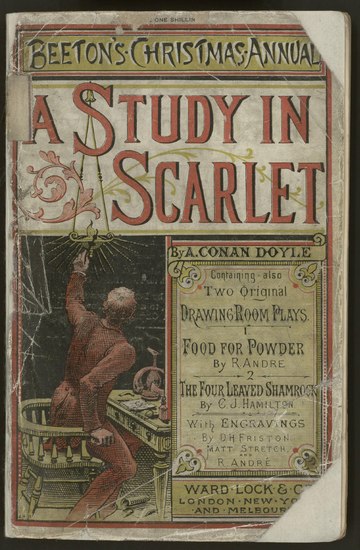
Nevertheless, today I choose to celebrate the 1887 publication of Beeton’s Christmas Annual, a publication which appeared yearly in the UK between 1860 and 1898, and which was founded by Samuel Orchart Beeton, the husband of Britain’s more famous “Beeton,” Mrs-Isabella-of-the-same-last-name. Twenty-six years earlier, he’d published her own definitive and massive tome, (Mrs) Beeton’s Book of Household Management, the distillation of a number of installments that had begun appearing in The Englishwoman’s Domestic Magazine some years prior.
When I was a kid, the “Annual” was still quite a thing, usually published for Christmas, just like Beeton’s. Rupert the Bear had an annual. So did June (The Girls’ Magazine). And Look and Learn (a weekly children’s publication focusing on history and science). I especially looked forward to the Z-Cars Annual, which revolved around a weekly television series telling the stories of a couple of teams of policemen and their signature vehicles (the Z-Cars). While the TV series itself was probably too advanced (it was thought of–for the time–as “gritty”) for children like me, Granny let me watch it anyway, and I remember its early coppers, such as Jack Lynch and Fancy Smith–an achingly young Brian Blessed–and its introduction to the world of future stars such as Judi Dench, John Thaw, and Joss Ackland. The extension of the series, in the form of the “Annual” was more aimed at kids, and I devoured them too, in something like what’s known these days as a “graphic novel” format.
It was only many, many years later that I came to understand that some of the earliest episodes of what was, at the time, a beloved family TV program had been directed by an absurdly young and inexperienced up-and-comer named Ridley Scott. And came to appreciate its place in TV history.
But I digress.
Back to 1887.
136 years ago today, on December 1, 1887, in that year’s Beeton’s Christmas Annual, Samuel Orchart Beeton published A Study in Scarlet, marking the first appearance in print of Sherlock Holmes and Dr. Watson, soon to become the most famous collaboration in detective (and perhaps all of literary) fiction.
It’s another marker of my childhood.
A month or two after my family had moved, in October 1963, from the UK, via Nigeria, to Boston and Harvard, and while I was in the fourth grade, I developed whooping cough. It was viewed as a very serious illness, and I was quarantined and removed from school for several weeks.
I couldn’t do much else to amuse myself but read. Dad introduced me to C.S. Forester’s Hornblower series. I read all those published to date. I read Gone With The Wind. And Jane Eyre and Wuthering Heights. And then (thanks to Dad again), I encountered Sherlock Holmes and Doctor Watson.
By the time I went back to school I’d read the whole bloody lot, short stories, novels, and all. And found faithful and loyal friends to last me a lifetime.
Not such a “bleak December” after all.
Do young folks still read like this, and find comfort for the ages by doing so?
I hope so.
My mother wasn’t much of a reader. But she did love Matt Monro. So, here you go:
