
 It was the first of Bernard Cornwell’s “Richard Sharpe” novels to be published, although it ended up, over the decades, being eighth in the chronological order of our hero’s history.
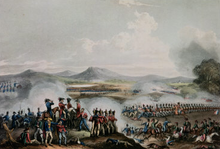
It was set in July of 1809, amidst the Battle of Talavera, an iconic bookmark during the Peninsular war between the Napoleonic armies and those of Britain, Spain, and Portugal.
I cannot recommend the ITV “Sharpe” series highly enough. (You can begin your adventure on Amazon, here.) Yes, the production values are dated, and sometimes pretty crummy. But the episodes have so much “heart” that such quibbles seem petty, if not downright irrelevant.
There are those casting decisions which cause consternation to begin with, but which end up being so sublimely “right” that we cannot imagine any other actor in the role. I remember an interview with Bernard Cornwell, author of the “Sharpe” series, in which he expressed his initial unhappiness with Sean Bean’s being cast in the role for the ITV serializations of his novels. Sharpe, you see, was clearly described in Cornwell’s first few books (which I really do love) as having very dark, even black, hair; Sean Bean’s hair is of a decidedly blonder shade.
Then, Cornwell watched the first Sharpe episode on television.
“After that,” he said, “I never mentioned the color of Richard Sharpe’s hair again.”
I have a special fondness for the ITV series because, in 2007, not long before my father died, I visited him in the UK for several weeks, bearing my “complete series” of the programs on DVD. We watched most of them together. He loved them. And I thought, then, as I do now, how much he and Richard Sharpe had in common.
Some scant months later, I found myself standing in front of the congregation at St. Mary’s Church in Dilwyn, delivering a few remarks as the oldest of Dad’s children, the one known among the family–sometimes dismissively–as “the American one.” (A badge I wear proudly.)
Here–among much else–is what I said:
So, what about Lieutenant, later Major, Richard Sharpe? Although Dad came to Sharpe much later in life, he read the Cornwell books avidly, and when he discovered the television series and the DVDs, he was captivated again. He never tired of watching them, and he loved to recount the battle honours of Sharpe’s regiments as compared to his own.
What is it about Richard Sharpe that so appealed to Dad? His bravery, without question. His leadership? Absolutely. His forthrightness? No doubt. His eye for a comely lady? Certainly. But what sealed the bargain for Dad, I think, is Richard Sharpe’s loyalty to his men, and his sense of duty. Once Richard Sharpe is on a mission, you know that he will stop at nothing to insure the triumph of good over evil, and of decent men over the fools and knaves with which he often finds himself surrounded. And he won’t quit until the job is done. As the redoubtable Sergeant Harper once put it: “Oh, you can’t stop Captain Sharpe, sir. You can get behind him or you can walk away from him. But don’t ever try to stand in his way.”
When it came to Dad, truer words were never spoken. He could fight. He could fire “three rounds a minute.” But–by gum–Dad could also stand. For England, and the for the free world:
That clip describes the scene just before the Battle of Talavera.
The Battle of Talavera concluded 215 years ago today, on July 28, 1809 with the defeat of the French and the ennoblement of Arthur Wellesley to the title of Viscount Wellington of Talavera. There were over fourteen thousand casualties, and it was one of the bloodiest battles of the war.
Oh, and if you want to know what happened to “Sharpe’s Eagle,” I’m afraid you’ll just have to read the book or watch the program. I promise you, it’s time well spent.
