
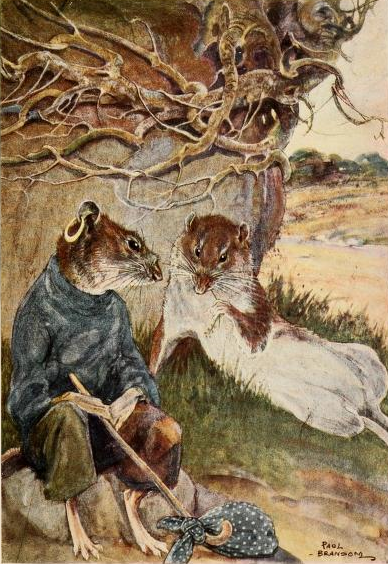
He thought his happiness was complete when, as he meandered aimlessly along, suddenly he stood by the edge of a full-fed river. Never in his life had he seen a river before—this sleek, sinuous, full-bodied animal, chasing and chuckling, gripping things with a gurgle and leaving them with a laugh, to fling itself on fresh playmates that shook themselves free, and were caught and held again. All was a-shake and a-shiver—glints and gleams and sparkles, rustle and swirl, chatter and bubble. The Mole was bewitched, entranced, fascinated. By the side of the river he trotted as one trots, when very small, by the side of a man who holds one spellbound by exciting stories; and when tired at last, he sat on the bank, while the river still chattered on to him, a babbling procession of the best stories in the world, sent from the heart of the earth to be told at last to the insatiable sea.
One of the surest and most comforting of my childhood literary companions was Kenneth Grahame’s The Wind in the Willows. Rather more advanced, and infinitely less twee than Winnie-the-Pooh, it nicely bridged the anthropomorphic gap between Beatrix Potter on the one hand, and George Orwell and James Herriot on the other. I love its dual themes of wanderlust, and longing for and love of, home. (I suspect this has a lot to do with its immediate popularity in the face of much negative criticism when it was first published in 1908, as I daresay many expats, both young and old, found it reassuring and charming.) And I love the characters, many of whom I came to realize later in life behave not so much as childish little people (well, Toad, on many occasions), but rather mimic characteristics of Downton Abbey era English gentlemen, with their fast motor cars, their velvet smoking jackets, their vast estates and cozy homes, their classism, and their love of fine food.
Kenneth Grahame was born in Edinburgh, 165 years ago, on March 8, 1859. His mother died when he was five, and his father–who was a drunkard–turned Kenneth and his brother over to the care of his grandmother. Numerous biographies (and Wikipedia, for a quick read) attribute much of Grahame’s fascination with the natural world, and his ability to apply the eccentricities of human behavior so evocatively to woodland animals to his:
[living in] a spacious, dilapidated house called The Mount, in expansive grounds, [where they] were introduced to the riverside and boating by their uncle, David Ingles, who was a curate at Cookham Dean church and later at Cranbourne church. This ambience, particularly Quarry Wood and the River Thames, is believed by Grahame’s biographer Peter Green to have inspired the setting for The Wind in the Willows.[2] However, after less than two years, after the chimney collapsed at Christmas in 1865, Kenneth went with Granny Ingles to live at Fernhill Cottage, Cranbourne. (Wikipedia Grahame page).
Family finances precluded Grahame’s dream of pursuing studies at Oxford, and he ended up being sent to work at the Bank of England, where he did quite well, retiring after an abortive assassination attempt in 1908.
Like many of his generation, Kenneth Grahame began composing stories for children known to him; in his case, for his blind and challenged son, Alistair. The bedtime stories told by a loving father to his very compromised son eventually turned into The Wind in the Willows.
Alistair Grahame, who’d lived out his father’s dream of attending Oxford University, killed himself on a railway track at the age of nineteen, in May of 1920. When his father died, a dozen or so years later, he was buried beside his son, in the same grave.
I’m humbled when I read the biographies, or just the stories, of men who led impossibly sad and difficult lives, but who somehow climbed outside themselves and beyond their own misery, producing works which have brought so much joy to so many, for so long. Edward Lear and Christopher Smart spring immediately to mind, but there are many, many, more (Rudyard Kipling, perhaps. And–although she was born into a fairly affluent family–Beatrix Potter’s life wasn’t exactly a poster for White Victorian Colonial Privilege, trust me).
It draws such a contrast for me when it comes to the reverse. I’ll draw a curtain over most of my thoughts here, and pick out at random–umm–the writers of the “Beat Generation.” Among them, William S. Burroughs, Allen Ginsberg, Jack Kerouac. Those guys, and a few others. Psychopaths. Narcissists. Criminals. Lunatics. Mysogynists (this probably explains the paucity of women in the movement).
I don’t think the idea of spreading joy to others ever entered their narrow, perverse, and chemically-assisted little minds. Selfish bastards, determined (as far as I can see) to make everyone else as miserable and dysfunctional as themselves. Ugh.
He saw clearly how plain and simple – how narrow, even – it all was; but clearly, too, how much it all meant to him, and the special value of some such anchorage in one’s existence. He did not at all want to abandon the new life and its splendid spaces, to turn his back on sun and air and all they offered him and creep home and stay there; the upper world was all too strong, it called to him still, even down there, and he knew he must return to the larger stage. But it was good to think he had this to come back to, this place which was all his own, these things which were so glad to see him again and could always be counted upon for the same simple welcome–The Wind in the Willows
Home.
I was at home today. And one of my simple, special, pleasures was this:

Introducing about 300lbs of dogs to about five pounds of four-day old lamb. They’re Great Pyrenees, so it’s their nature to guard and watch, rather than to shred and eat. So much fun. So delightful. So always glad to see me.
Home. Like Ratty, Mole and Badger, I’d rather be here than anywhere else. And I’m so grateful to the literary companions of my childhood for teaching me that’s all I need, to be content.
